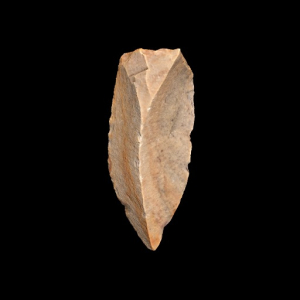
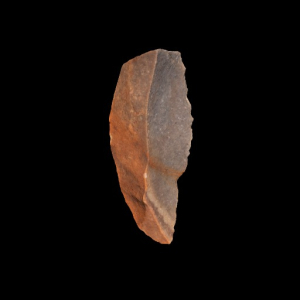
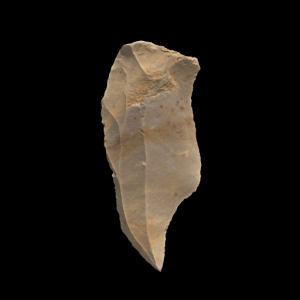
Type: Macroblade
Location: Djarra, Queensland
Age: Late Holocene
Material: Quartzite
MoST ID: 6917
Pedestal Link: https://une.pedestal3d.com/r/jqfz5LI6pI
Model Author: Mary-Anne Stone
This quartzite macroblade is from northwest Queensland. Macroblades proliferated in the Late Holocene in Australia, after ca. 5000 BP, and were made into the the recent past. They were used as spearpoints, knives, and general cutting and scraping tools. The macroblade is an heirloom of a Pitta Pitta family from Boulia.
This macroblade was struck from a blade core using a hammerstone. The macroblade propagated under an elongated zone of high mass created by parallel negative scars on the core face. The core platform was a cortical surface. The macroblade is not retouched, and its function is unclear: pointed macroblades might be spearpoints or knives, or unused debris from core reduction.
See the annotations for technological details about this stone tool.
Blades are elongated flakes that measure at least twice as long as they are wide. In Australia, a blade measuring more than about 40 mm long is referred to as a ‘macroblade’. Macroblades were made by hard-hammer percussion following various strategic methods. The Camooweal Method of macroblade manufacture, practiced in northwestern Queensland, has been described in detail.
Macroblade manufacture emerged in Australia in the Middle Holocene, by about 7000 BP, and proliferated from about 5000 BP. They were made into the recent past. Macroblades are common in stone artefact assemblages across Northern and Central Australia, and large macroblade manufacturing quarries are found throughout the region. They were extensively traded, a practice which continued into the 1990s in the Northern Territory. In the historic period, macroblades were made for use as knives with wood or resin handles, or were hafted as armaments on darts cast with spearthrowers. Some macroblades were exceptionally large, although most encountered by archaeologists measure less than 100 mm long. Macroblades are often found without signs of retouching that might provide clues to their use.
Archaeologists often divide retouched macroblade points into unifacial and bifacial variants. Unifacial points are usually retouched towards the dorsal surface to create the distal point and shape the edges, with unifacial or bifacial flaking at the proximal (platform) end to thin and shape it for hafting. Bifacial points are retouched to both faces along both margins. Macroblades were sometimes shaped in certain ways to produce regionally-specific tool types, such as Juan knives in Queensland and Yilugwa knives in Central Australia. Large-sized Pirri Points were sometimes made by pressure flaking on macroblades.
Some archaeologists think that unifacial points turned into bifacial points through resharpening. This may have been true in some cases, but the narrow width of macroblades does not allow for the type of bifacial thinning seen on, for instance, Kimberley Points or Northern Territory Triangular Points. Other bifacial points, such as Wanji Bifaces and some bifacial points in western Queensland, were made on tabular pieces of raw material and not macroblades.